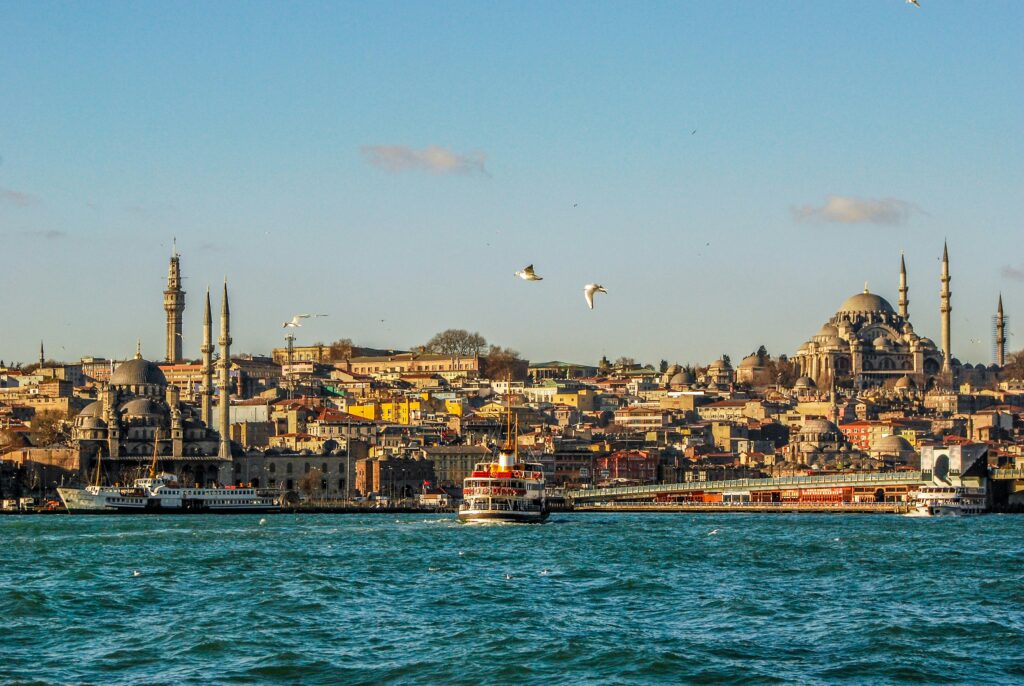
The Nazar Boncuğu — or blue evil eye — is more than a charm. It’s a cultural mirror reflecting centuries of belief, protection, and artistry in Turkey.
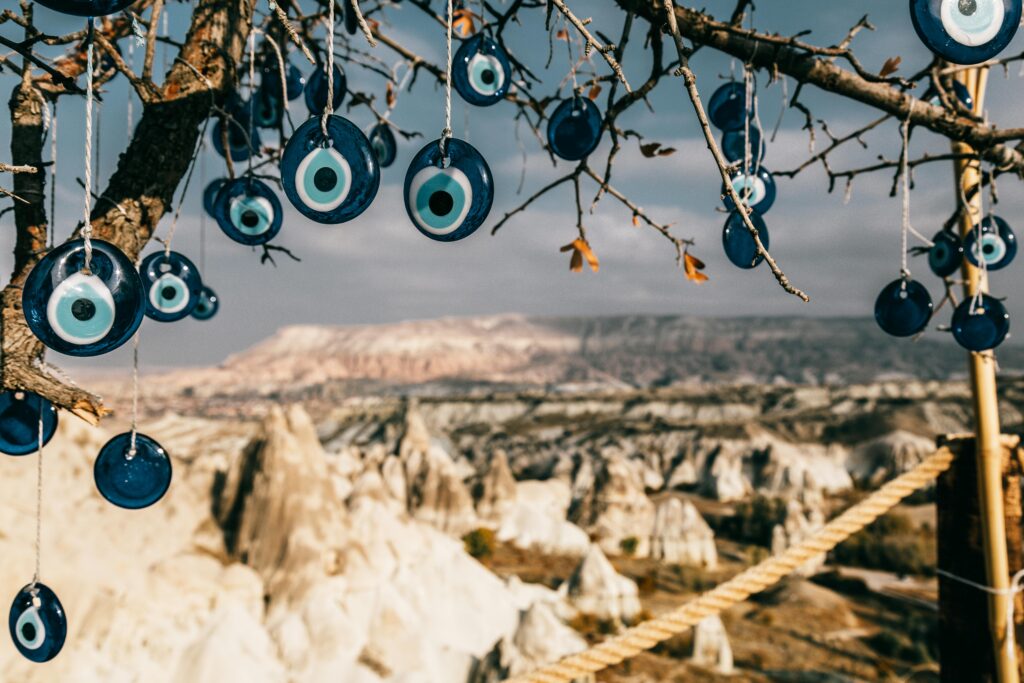
1. The Eye That Never Sleeps
It hangs from car mirrors, glints from jewelry, guards doorways, and greets travelers at airports.
The blue eye, known as Nazar Boncuğu in Turkish, is perhaps the most recognizable symbol in Turkey — at once mystical and familiar, ancient and modern.
People buy it for protection, gift it for blessings, and hang it for peace of mind. Whether you believe in superstition or not, one truth endures: the Nazar has become a visual language of Turkish life — a symbol that transcends religion, geography, and time.
2. The Belief Behind the Blue
At its heart, the Nazar represents protection from envy and ill will.
According to Anatolian folklore, misfortune is not random — it’s the result of “the evil eye,” a look charged with jealousy or admiration so intense that it carries unintended harm.
The blue glass eye serves as a shield, absorbing that energy before it reaches its target.
When it breaks, people say, the charm has done its job — it has intercepted negativity and released it.
While belief in the evil eye exists across the Mediterranean and Middle East, in Turkey it’s woven deeply into everyday life. Babies receive their first Nazar at birth. Couples hang one in new homes. Shopkeepers keep them near their cash registers. Even modern architects quietly embed them in new constructions, as though to preserve continuity with the unseen.
3. From Myth to History: A 5,000-Year Legacy
The origins of the evil eye reach back more than 5,000 years, to ancient Mesopotamia and Egypt. Early references appear on clay tablets and amulets found in archaeological sites around the Tigris River, long before the emergence of monotheistic religions.
In these civilizations, the eye was considered both a window and a weapon — it could see truth, but also transmit harm. To neutralize this dual power, artisans began to depict a protective “counter-eye” — a gaze that watches back.
This ancient motif later traveled through Greek, Roman, Byzantine, and Ottoman cultures, each adding its own symbolism. The Greeks called it mati, the Romans used glass pendants for sailors, and the Ottomans elevated it to an art form.
Across time and empires, one element never changed: the belief that the human eye, for all its beauty, could also be dangerous.
4. The Art of the Flame: Where Glass Becomes Spirit
Behind every Nazar Boncuğu lies fire — the element that transforms raw glass into a vessel of meaning.
The craft of making these charms, known as “Çeşm-i Bülbül” (literally “the Nightingale’s Eye”), is still practiced in a handful of workshops around İzmir’s villages of Görece and Kurudere.
Here, master artisans work in front of roaring furnaces, turning molten glass with iron rods, layering colors one over another: deep cobalt, milky white, and inky black at the center.
Each piece is made by hand; no two are ever exactly alike.
The process demands precision, intuition, and a kind of meditation.
A single charm can take hours, and the furnace burns day and night — never allowed to go cold, just as the belief itself never sleeps.
For many artisans, the craft is both inheritance and devotion — passed down through generations, a balance of skill and superstition that continues to glow at 800 degrees Celsius.
5. Why Blue? The Meaning of Color
Blue has always been a color of protection.
In ancient civilizations, it symbolized the sky, water, and eternity — elements believed to guard life from chaos.
There’s also a deeper layer: in regions where blue eyes were rare, they were thought to carry mystical power. The Nazar’s shade — between sapphire and turquoise — is not just beautiful; it’s psychological. It cools, calms, and draws the gaze without aggression.
Today, while traditional cobalt remains iconic, contemporary artisans experiment with turquoise, green, gold, and even minimalist white glass eyes for modern interiors.
Yet the spirit remains unchanged: blue, in all its variations, continues to symbolize safety, serenity, and the sacred.
6. Across Cultures and Religions
Although strongly associated with Turkey, the Nazar is part of a global belief network.
It connects to symbols across civilizations — each a variation on the same human instinct to protect, to ward off, to believe.
- In Judaism, the Hamsa Hand (or Hand of Miriam) represents the “eye of God” watching over humanity.
- In Islam, the same motif is known as the Hand of Fatima, honoring the Prophet’s daughter, and often paired with a blue eye in its center.
- In Hinduism and Buddhism, the symbol aligns with the third eye chakra, representing inner vision and awareness.
- In ancient Egypt, the Eye of Horus guarded travelers and rulers, painted on tombs and ships alike.
What ties all these variations together is not doctrine, but emotion — a shared need to make the invisible visible, to feel safe in a world that often isn’t.
7. The Modern Nazar: From Talisman to Design Icon
Over time, the Nazar has evolved from a sacred object into a modern design motif — appearing in art, architecture, and fashion far beyond Turkey’s borders.
You’ll find it in boutique hotels, coastal villas, and contemporary jewelry collections, often reinterpreted through minimalist forms.
Interior designers hang oversized Nazar discs on whitewashed walls, stylists layer them into gold chains, and ceramicists glaze them into household pottery.
Yet despite its aesthetic rise, its spiritual weight remains intact. For many, it’s not about superstition anymore but about continuity — keeping an ancestral symbol alive in modern life.
As one Turkish designer once put it, “We don’t hang the Nazar because we fear bad luck; we hang it because it feels like home.”
8. When the Eye Breaks
There’s a moment every believer knows: the quiet crack of glass.
It’s said that when a Nazar Boncuğu breaks, it has fulfilled its purpose — it has absorbed negative energy meant for its owner.
Rather than sadness, it brings a sense of relief. The broken charm is never thrown away casually; it’s wrapped, buried, or returned to nature with gratitude.
A new one takes its place, and the cycle begins again.
Even skeptics often find comfort in this ritual — a poetic acknowledgment that sometimes we all need symbols to remind us that we are protected, that life can be cleansed and renewed.
9. The Gift of Good Energy
In Turkey, gifting a Nazar is an act of affection and care.
It accompanies nearly every life milestone: the birth of a child, a wedding, a new home, a promotion, or even the purchase of a car.
To give one is to say, “I wish you peace, safety, and good fortune.”
Shops and bazaars across the country display hundreds of designs — from tiny glass beads to grand wall ornaments, from handcrafted jewelry to modern reinterpretations in metal and wood.
Because they’re light and symbolic, they’ve become one of the most beloved souvenirs travelers take home — a tangible piece of Turkey’s protective spirit.
10. A Symbol Between Belief and Beauty
What makes the Nazar so enduring is its balance between meaning and aesthetics.
It’s beautiful even to those who don’t believe, and meaningful even to those who don’t collect objects.
It sits at the intersection of spirituality and design — a bridge between faith and form.
The circular shape, the radiating colors, the hypnotic gaze — all draw us into contemplation.
Perhaps the secret of the Nazar’s longevity is that it mirrors something in us: our desire to see and to be seen, to connect the visible and the invisible.
11. The Nazar in Contemporary Turkey
In the modern era, Turkey’s relationship with the Nazar reflects the nation itself — modern yet traditional, secular yet spiritual.
It’s equally at home in a minimalist Istanbul apartment as it is in a rural Anatolian farmhouse.
Even technology hasn’t escaped its reach: people now share digital Nazars as emojis, stickers, and social media icons.
And while younger generations may not recite old folk stories, they still hang the charm in new cafés, coworking spaces, and even start-up offices.
It’s no longer about superstition; it’s about belonging to something older than yourself — a cultural rhythm that hums quietly beneath the surface of daily life.
12. Beyond Protection: What It Really Means
Ultimately, the Nazar is not about fear of bad luck but hope for harmony.
It represents the human wish to live in peace with others — to be surrounded by good intentions, to balance giving and receiving energy.
Seen this way, it’s less a superstition than a philosophy of empathy: that what we feel toward others matters, that our gaze carries weight.
In a time when attention is currency and envy travels faster than ever, the Nazar reminds us to look gently, to wish well, and to protect each other through awareness.
13. The Universal Language of the Eye
Walk through any market in Istanbul, Bodrum, or Cappadocia, and you’ll see thousands of blue eyes sparkling under the sun.
Each one catches the light differently, yet they all seem to watch in the same quiet way — alert but benevolent, patient but powerful.
Tourists buy them for luck; locals keep them for love.
Some believe, some don’t — but everyone, in some way, understands them.
That’s the genius of the Nazar: it doesn’t demand belief, only recognition.
It’s the perfect metaphor for Turkey itself — a meeting point of worlds, old and new, sacred and everyday.
14. The Enduring Gaze
The Nazar’s story continues to evolve, but its essence remains unchanged.
It’s the same eye that watched over caravans on the Silk Road, fishermen at sea, and families in stone villages centuries ago.
Today it still watches — from city balconies, from car dashboards, from necklaces resting on modern skin.
Its gaze has outlived empires, fashions, and philosophies.
And perhaps that’s the real power of the blue eye: it doesn’t just protect against misfortune; it reflects the enduring human need to believe in something that watches over us, even when we cannot see it.