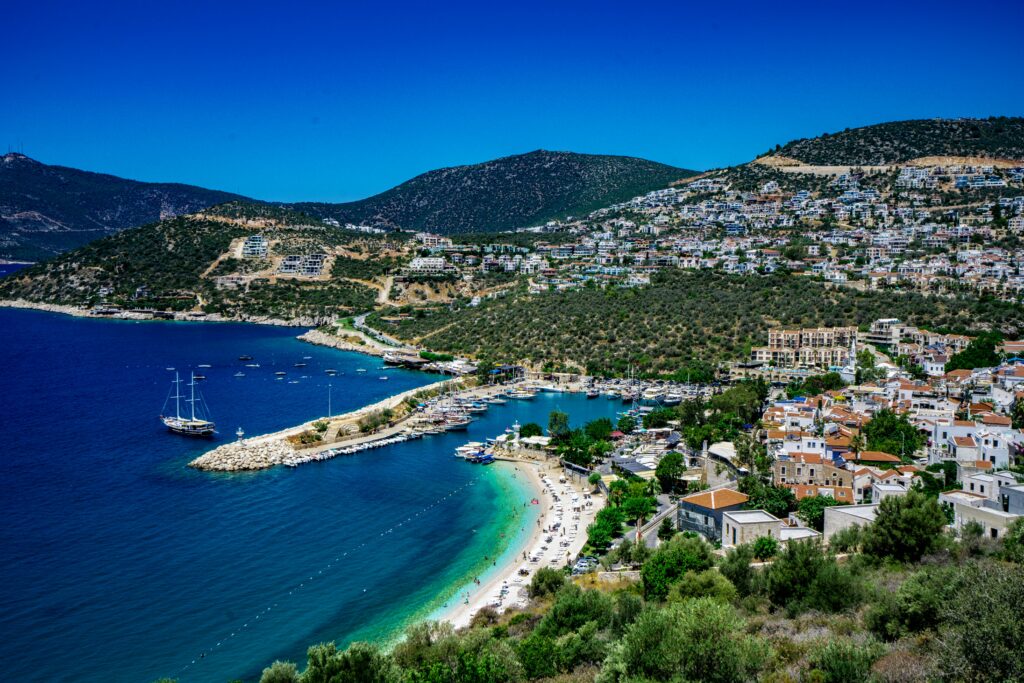
Once a sleepy fishing town, Kalkan has become one of Turkey’s most elegant coastal destinations — where old-world charm meets discreet modern luxury.
1. Where the Mountains Meet the Sea
Kalkan doesn’t announce itself loudly.
It doesn’t need to. Nestled between the Taurus Mountains and the turquoise sweep of the Mediterranean, this small coastal town on Turkey’s Lycian coast is the kind of place that reveals itself slowly — in the sound of water lapping against stone, in the scent of thyme drifting from hillside terraces, in the glow of whitewashed walls at dusk.
For years, Kalkan was known only to a few — sailors, artists, and travelers who valued its understated beauty. But word spreads. And now, without losing its soul, Kalkan has quietly become one of the Mediterranean’s most coveted addresses — a refuge for those seeking serenity, sophistication, and sea views that stop time.
2. From Fishing Village to Fine Living
Kalkan’s story is one of evolution without erasure.
Founded by Greek and Ottoman traders in the 1800s, it was once a modest port where wooden gulets carried olives, grapes, and almonds to nearby islands. When the population exchange of 1923 reshaped Anatolia, the Greeks left their mark in the town’s distinctive architecture — narrow cobbled streets, stone houses with wooden balconies, and bougainvillea cascading like ribbons of magenta.
Decades later, British travelers discovered this hidden harbor and fell under its spell. Instead of sprawling resorts, Kalkan welcomed boutique hotels, villas, and restored townhouses — blending heritage with comfort. The result is a town that feels both authentic and refined: a place where tradition hasn’t been replaced by modernity, only elevated by it.
3. The Secret Appeal of the Celebrities
Kalkan’s charm lies not in who visits but in how they visit.
Here, fame finds anonymity. It’s not uncommon to see well-known names strolling the marina, dining at waterfront restaurants, or sailing into the horizon — not for attention, but for escape.
Over the past decade, actors, musicians, and entrepreneurs have all found their way to Kalkan’s discreet villas and private bays. The reason is simple: unlike glitzy Riviera resorts, Kalkan offers luxury without spectacle. There are no paparazzi, no flashing cameras — only a kind of freedom that even fame can’t buy.
The two-hour drive from the nearest airport filters out mass tourism. What remains is a refined community — cosmopolitan yet unpretentious — where conversation drifts easily between English, Turkish, and the language of shared admiration for beauty.
4. Architecture That Frames the Horizon
One of Kalkan’s defining features is its architecture — a mosaic of old stone and modern glass, terraced into the hillside like an amphitheater facing the sea.
Every home seems designed to honor the view. Infinity pools melt into the horizon; open-plan living spaces blur the line between interior and exterior; shaded pergolas frame sunsets that turn the water to liquid gold.
Unlike many coastal towns, Kalkan’s growth has been guided by aesthetic restraint. The town center preserves its traditional Greek-Ottoman character, while the newer districts — Kalamar, Kızıltaş, Komurluk, and Ortaalan — showcase contemporary design rooted in natural materials: limestone, olive wood, and glass.
This architectural dialogue between past and present gives Kalkan its visual harmony — a Mediterranean palette balanced by modern geometry.
5. The Sea, Always Within Reach
Everything in Kalkan flows toward the water.
The marina, lined with sleek yachts and traditional gulets, hums with quiet energy. Locals and visitors gather at twilight to watch the sun slip behind the horizon, a ritual as ancient as the town itself.
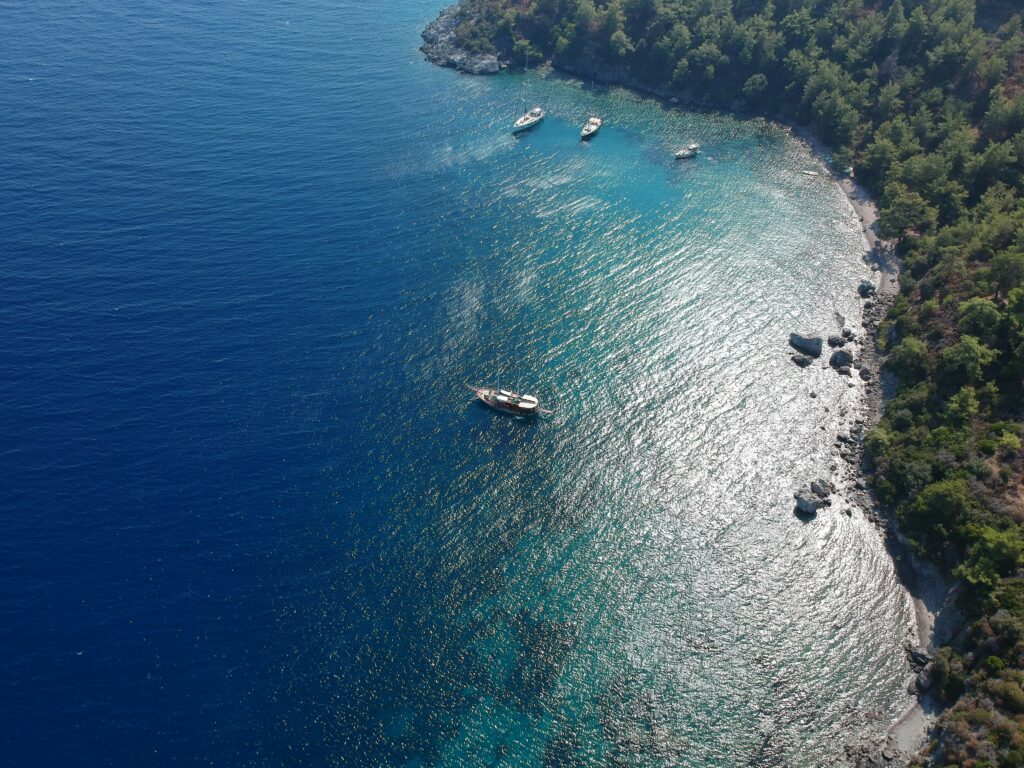
Beyond the harbor, a constellation of coves and islands invites exploration.
- Kaputaş Beach, perhaps the most photographed in Turkey, lies hidden at the foot of a canyon — 187 steps down to turquoise perfection.
- Patara, a 12-kilometer sweep of golden sand, feels infinite and untouched.
- For sailors, the surrounding bays — Firnaz, Kalamar, and Mouse Island — offer tranquil anchorages where the sea glows cobalt by day and silver by moonlight.
Even the water feels different here — softer, clearer, infused with a stillness that seeps into you.
6. Culinary Life: A Table by the Sea
Kalkan’s food scene is as layered as its landscape.
Once known for its modest taverns serving grilled fish and homemade meze, it now offers a culinary experience that rivals Europe’s coastal capitals — without the pretension.
Dining here is an act of atmosphere as much as flavor.
Many restaurants perch above the harbor, their terraces draped in vines and fairy lights, their tables set for lingering conversations.
Favorites include modern Mediterranean menus where octopus, sea bream, figs, and pomegranates become artful expressions of the region’s abundance.
For those who prefer simplicity, local fishermen still bring in the day’s catch at dawn, sold fresh in the old market.
And in the early morning quiet, the scent of simit (sesame bread) mixes with jasmine and salt air — Kalkan’s breakfast aroma, impossible to forget.
7. A Haven for Design and Craftsmanship
Beyond its beaches, Kalkan has become a hub for design enthusiasts and collectors.
Boutiques tucked along the cobbled streets sell ceramics, woven textiles, and hand-carved olive wood, while art galleries display the works of local and international painters inspired by the light of the Lycian coast.
Many homeowners here collaborate with Turkish artisans to craft interiors that reflect the landscape — minimalist yet soulful, rooted in texture rather than ornament.
Natural stone floors stay cool underfoot, linen drapes flutter in sea breezes, and handmade pottery catches the sun’s reflection.
It’s this attention to craft — this respect for material and maker — that gives Kalkan its quietly luxurious aesthetic. It feels designed, but never staged.
8. The Rhythm of Life
Life in Kalkan moves to its own metronome — unhurried, sunlit, human.
Days begin with coffee on the terrace, shift into swims and market strolls, and end with golden light spilling over the rooftops.
Evenings bring music — not the loud, pulsing kind, but the soft echo of jazz or traditional Turkish tunes drifting from the harbor.
Locals chat in low voices, cats weave between café tables, and the night smells faintly of citrus and sea salt.
This rhythm has a way of resetting the body and mind. For visitors, it’s restorative. For residents, it’s addictive — the kind of peace that lingers even after you leave.
9. Kalkan and the Lycian Heritage
Kalkan sits within the ancient region of Lycia, a land once ruled by seafaring civilizations whose tombs and temples still crown the nearby hills.
Within an hour’s drive, you can walk among the ruins of Xanthos, Letoon, and Patara, all UNESCO World Heritage sites that reveal a mosaic of Anatolian and Hellenic cultures.
The Lycian Way, a 500-kilometer hiking trail that stretches from Fethiye to Antalya, passes just above Kalkan. Trekkers follow ancient footpaths through pine forests, olive groves, and coastal cliffs — often ending their day with a swim in the same waters that once carried Lycian ships.
For history lovers, Kalkan is not just a beach town — it’s a gateway to a world that feels simultaneously ancient and alive.
10. Sustainability and the Future
Kalkan’s growing popularity brings responsibility.
Over the past decade, a new generation of local entrepreneurs and architects has championed eco-conscious tourism and construction, focusing on renewable energy, low-impact design, and water conservation.
Luxury villas are now being built with solar panels, native landscaping, and materials sourced from nearby quarries.
Restaurants prioritize local ingredients and seasonal menus, reducing import waste while celebrating regional cuisine.
This movement isn’t just about sustainability — it’s about preserving Kalkan’s equilibrium, ensuring that the very beauty attracting people here remains intact.
11. Real Estate: Living the View
Kalkan’s real estate landscape mirrors its personality — exclusive, elegant, and diverse.
Buyers come seeking both investment and identity: seafront villas, hillside retreats, and historic homes restored with modern grace.
Prices have risen steadily, reflecting the town’s international demand, but compared to the Western Mediterranean, Kalkan still offers exceptional value.
What makes ownership here distinct is the sense of belonging that comes with it — the feeling that your home is not just a property, but part of a living canvas overlooking one of the most breathtaking coastlines in the world.
Whether for full-time residence, seasonal living, or rental investment, Kalkan offers not just returns, but renewal.
12. A Discreet Kind of Glamour
Kalkan’s beauty lies in its restraint.
It doesn’t seek attention; it earns admiration.
It’s not the kind of destination where you “see and be seen” — it’s where you finally stop needing to.
Celebrities who visit often say the same thing: here, they rediscover the simple luxuries — privacy, conversation, sunlight, silence.
In Kalkan, glamour doesn’t glitter; it glows softly, like candlelight reflected on the sea.
13. How to Reach This Hidden Corner
Part of Kalkan’s exclusivity comes from its geography.
The nearest airports — Dalaman and Antalya — are both around two hours away by scenic coastal road. The drive itself is part of the arrival: pine-covered cliffs dropping into turquoise water, glimpses of small villages and hidden bays along the way.
This distance from the mainstream is Kalkan’s quiet secret. It keeps mass tourism at bay, ensuring that the town remains what it has always been — intimate, tranquil, and distinctly itself.
14. The Essence of Kalkan
Every traveler who comes to Kalkan eventually feels the same sensation — a kind of calm that has no name.
It’s in the slowness of the morning light, the rhythm of the waves, the warmth of people who greet you as if you’ve always been here.
Kalkan teaches you how to live differently — not faster, not grander, but truer.
And that’s why people return year after year, not for novelty but for familiarity — for the feeling of coming home to a place that still feels unspoiled, luminous, and alive.