Discover the Bosphorus — the strait that defines Istanbul’s soul, connecting continents, cultures, and centuries.
1. The Waterway That Shaped a City — and a Civilization
There are few places on Earth where geography feels alive, where water is not just scenery but a force that shapes everything it touches.
For Istanbul, that force is the Bosphorus Strait — the 32-kilometre ribbon of blue that divides the city between Europe and Asia, and unites it in spirit.
It’s not merely a waterway; it’s the heart of Turkey’s story. Every empire that touched these shores — Greek, Roman, Byzantine, Ottoman — rose and fell by its rhythm.
Even today, the Bosphorus dictates how Istanbul breathes, how it moves, and how it dreams.
To understand Istanbul, start with the water.
2. A Geography Written in Light
From the northern Black Sea to the inland Marmara, the Bosphorus twists and narrows like a living artery.
Its depth drops to 120 metres; its currents flow in opposite directions above and below, shaping the city’s temperament — calm at dawn, restless by night.
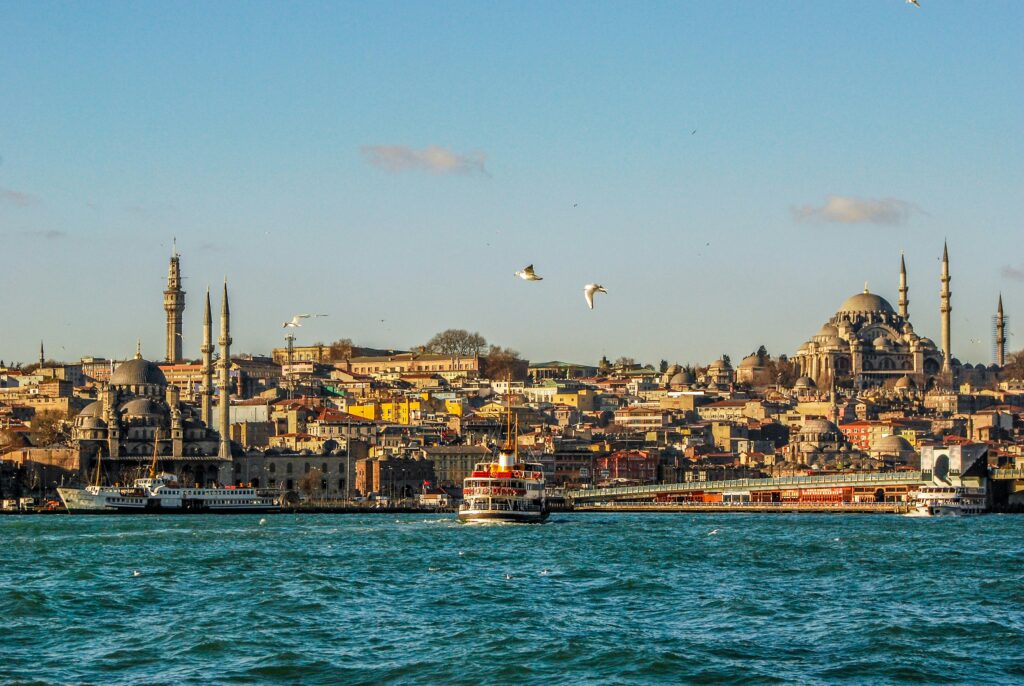
Standing on the European shore, you see the Asian hills shimmering in the distance. Turn around, and modern towers rise behind Ottoman domes.
That duality — of continents, cultures, and centuries — is Istanbul’s signature.
At sunrise, fishermen cast lines near Ortaköy Mosque; at night, ferries cross the water like fireflies.
For millions of residents, the Bosphorus is both daily commute and eternal backdrop.
3. A Timeline Carved in Stone and Story
The Bosphorus is older than Istanbul itself — a geological corridor born millions of years ago when tectonic shifts opened a channel between seas.
7th century BC: Greek colonists founded Byzantium on its European bank.
330 AD: Constantine chose it as the capital of the Roman world, calling it Nova Roma — New Rome.
1453: Sultan Mehmed II’s conquest of Constantinople turned the strait into the beating heart of the Ottoman Empire.
1936: The Montreux Convention gave modern Turkey full control of its passage, securing sovereignty over one of the world’s busiest maritime routes.
Today, that control remains both a strategic asset and a symbol of identity — a reminder that Turkey’s destiny has always flowed through this channel of blue.
4. The Bridges That Unite Two Worlds
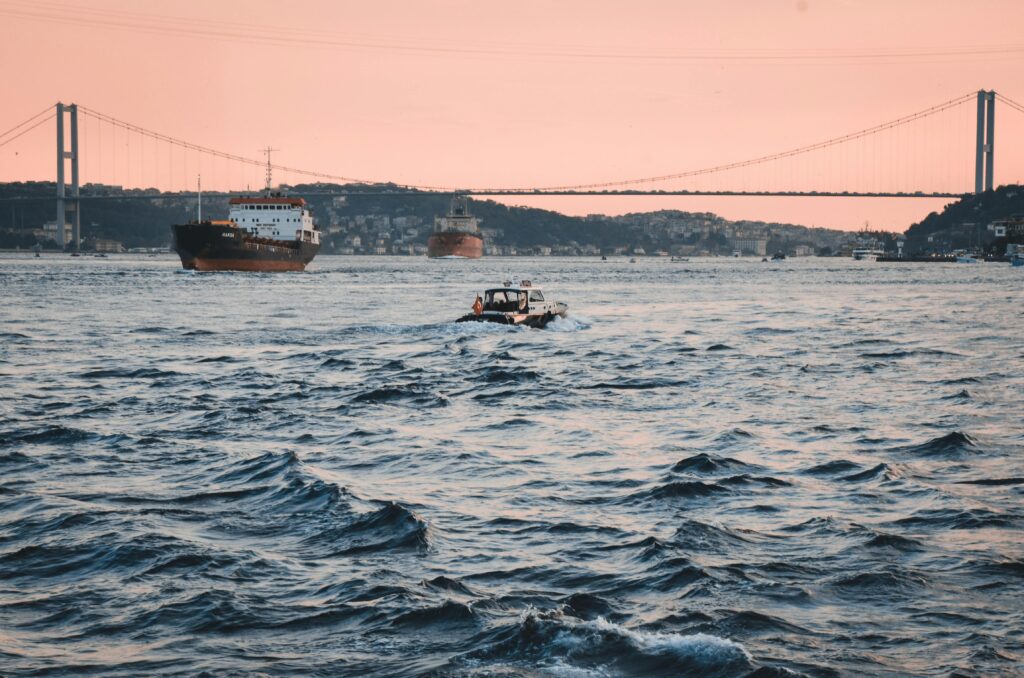
The Bosphorus is crossed not just by ferries, but by feats of modern engineering that redefine Istanbul’s skyline.
- 15 July Martyrs Bridge (1973): The first link between continents; its lights mark the city’s skyline like a string of pearls.
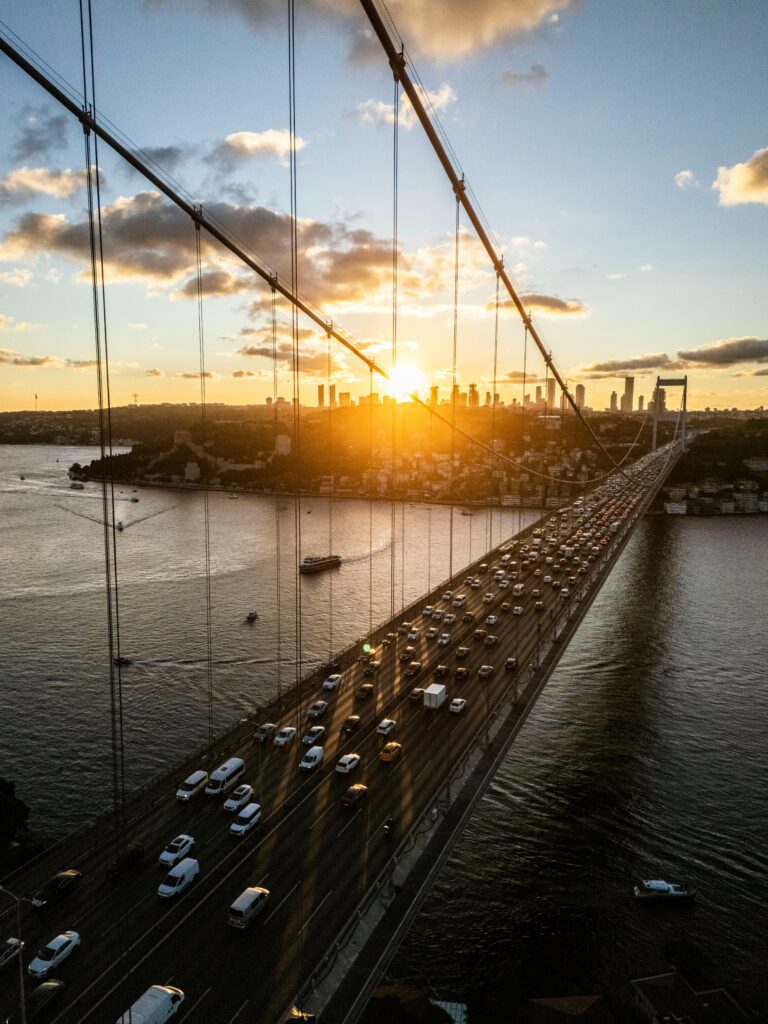
- Fatih Sultan Mehmet Bridge (1988): Named after the conqueror who once stood on these cliffs, it carries millions daily across history.
- Yavuz Sultan Selim Bridge (2016): With the world’s tallest bridge towers, it represents Turkey’s forward-looking ambition.
Beneath them, the Eurasia Tunnel burrows 5.4 kilometres under the seabed, connecting two continents in a daily hum of progress — proof that Istanbul never stops reinventing itself.
5. Palaces, Fortresses, and Legends
Every curve of the Bosphorus hides a legend.
- Dolmabahçe Palace, where chandeliers outshine the sun, once housed sultans and statesmen.
- Rumeli Hisarı, the fortress built in just 80 days by Mehmed the Conqueror, still stands guard over the narrowest point of the strait.
- Maiden’s Tower (Kız Kulesi) rises alone from the southern waters — part lighthouse, part love story — its reflection dancing across centuries of poetry and cinema.
Between them stretch neighbourhoods like Arnavutköy, Bebek, and Üsküdar — each a living museum of Ottoman mansions, fishermen’s cafés, and sea-scented lanes.
6. Life Along the Water: Istanbul’s Living Mosaic
The Bosphorus isn’t a postcard; it’s a pulse.
From morning ferries to midnight tea, life unfolds in rhythm with the tides.
On the European shore, Beşiktaş buzzes with galleries, markets, and waterfront meyhanes. Emirgan blooms with tulips each spring.
Across the strait, Kadıköy and Üsküdar mirror that vibrancy — equal parts traditional and trendy.
The sea is the great equalizer. Students, artists, and executives share the same decks on public ferries, each lost in thought as the city glides by.
This effortless coexistence is what makes the Bosphorus a metaphor for Istanbul itself — diverse, dynamic, and deeply human.
7. The Culinary Shoreline
To taste Istanbul, follow the water.
Grilled mackerel sandwiches (balık ekmek) near Galata, meze tables in Arnavutköy, tea under plane trees in Kanlıca — each meal here is an act of belonging.
Restaurants like Sunset Grill, Bebek Balıkçısı, and Kuruçeşme’s modern meyhanes now blend Anatolian flavours with global finesse.
It’s this combination — of authenticity and ambition — that mirrors Turkey’s wider transformation.
The Bosphorus doesn’t just connect continents; it connects appetites.
8. The Bosphorus as an Economic Lifeline
Beyond beauty, the strait is one of the world’s busiest shipping lanes, carrying nearly 50,000 vessels annually.
Oil tankers, container ships, and cruise liners all pass through the same waters where fishermen still haul in seabass.
The government’s ongoing Canal Istanbul project aims to reduce congestion and environmental risk by creating a parallel passage west of the city.
But for now, the Bosphorus remains the maritime heartbeat of Turkey — linking the Black Sea economies to global trade routes.
For investors and homeowners alike, this constant movement fuels demand for waterfront real estate, logistics infrastructure, and hospitality ventures.
9. The Luxury of Perspective: Bosphorus Real Estate
Owning a view of the Bosphorus is a privilege that transcends generations.
The waterfront mansions known as yali — once summer retreats for Ottoman aristocracy — are among the most coveted properties in the world, commanding prices rivaling London and Monaco.
Modern apartments in Çengelköy, Üsküdar, or Tarabya offer spectacular views and strong investment returns, attracting global buyers seeking both lifestyle and legacy.
A Bosphorus home isn’t just an address — it’s a vantage point on history.
10. Cultural Identity and Global Perception
For centuries, the Bosphorus has shaped how the world sees Istanbul — as a city of contrasts and continuity.
Painters from Ivan Aivazovsky to Fikret Mualla, writers from Pierre Loti to Orhan Pamuk, and filmmakers from across the world have captured its reflections.
Each saw the same strait, yet each told a different story — of longing, of empire, of renewal.
In this sense, the Bosphorus is not just a location but a mirror of Turkish identity — a reminder that being between worlds can be a strength, not a compromise.
This city reminds us that to be a bridge is not a dilemma, but a gift.
Tradition and innovation, East and West, past and future — they coexist here, flowing in harmony like the current itself.
11. Environmental Responsibility: Protecting the Blue Corridor
The Bosphorus, like all living ecosystems, faces modern pressures — pollution, overfishing, and maritime traffic.
The 2021 “sea snot” crisis reminded Istanbul how delicate its balance truly is.
Since then, public and private initiatives — including shoreline restoration and stricter marine regulations — have focused on reviving biodiversity.
Projects to restore seagrass beds, limit tanker emissions, and expand ferry electrification are already reshaping the environmental future of the strait.
Istanbul’s own progress now depends on listening to the water that built it.
12. Experiencing the Bosphorus: A Modern Guide
There’s no single way to explore the Bosphorus — and that’s part of its allure.
- Ferry journeys: The classic way to see Istanbul’s skyline unfold, from Galata to Anadolu Kavağı.
- Private cruises: Sunset sails revealing palaces glowing gold across the water.
- Walking paths: From Bebek Park to Emirgan, locals jog, read, and watch ships drift by.
- Cultural stops: Visit Sakıp Sabancı Museum, Yıldız Park, and the Istanbul Modern — each a dialogue between art and place.
Every route, every ripple tells another version of the same story: Istanbul exists because of the Bosphorus.
13. A Tale of Two Continents
Stand on the deck of a ferry at dusk, and you’ll see it clearly: Europe on one side, Asia on the other — and Istanbul between them, suspended like a lantern between horizons.
That moment captures what the Bosphorus truly means.
It’s not a dividing line but a meeting line, a physical metaphor for Turkey’s identity as both bridge and destination.
This duality — ancient yet young, Eastern yet Western — is what attracts investors, travellers, and dreamers alike.
It also defines the nation’s cultural DNA: timeless value grounded in movement.
14. The Future Flows Forward
As Istanbul expands its global role, the Bosphorus remains its compass.
New projects — smart marinas, cultural hubs, sustainable housing — are being designed around the idea of connection rather than consumption.
From the Galataport redevelopment to digital-art installations on ferry docks, the city is reclaiming its waterfront as both heritage and innovation.
The Bosphorus has always been more than a border — it’s a reminder that progress and memory can flow together.
Conclusion: The Strait That Holds a Nation’s Soul
Every city has a landmark.
But Istanbul’s is not a monument of stone — it’s a river of light and history.
The Bosphorus is the thread that weaves together continents, cultures, and centuries.
It’s where empires began, where artists found their muse, and where modern Turkey still finds its reflection.
It is more than scenery — it’s an expression of a nation’s living identity, a place where time doesn’t stand still, it sails.