Published: April 2026 · Category: General · Reading time: ~9 minutes
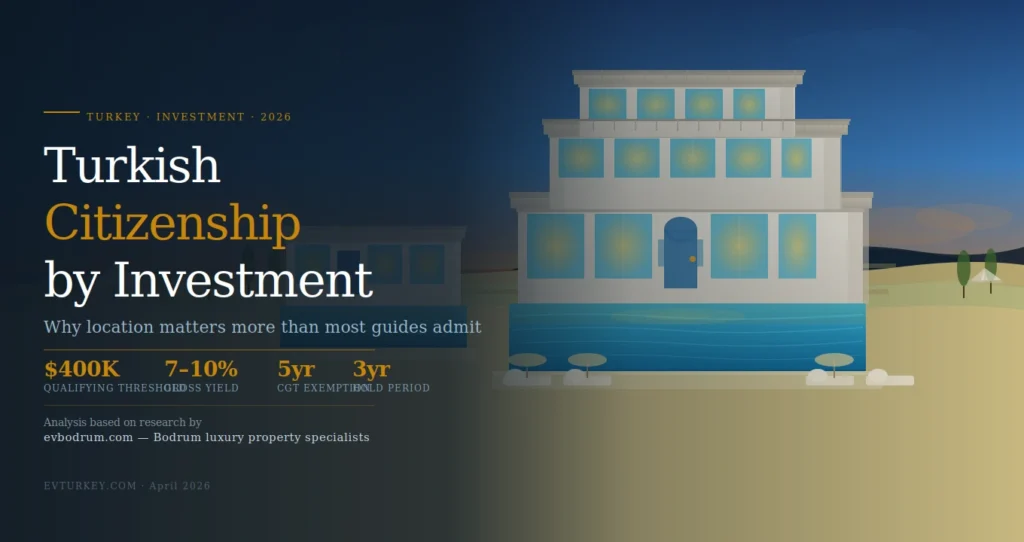
Every year, thousands of international investors qualify for Turkish citizenship through property investment. The threshold is clear — $400,000 in qualifying real estate, held for three years — and the outcome is the same regardless of where you buy: a full Turkish passport for you and your immediate family, access to 110+ countries, and eligibility for the US E-2 investor visa route.
What most citizenship guides won’t tell you is this: the city you choose changes nothing about the passport. It changes everything about the investment.
The $400,000 you lock up for three years is working capital. It should earn. It should grow. And when the hold period ends, it should exit into a real market — not just get recycled to the next citizenship applicant in the queue.
We’ve been covering life, business, and real estate in Turkey on EvTurkey for years. When it comes to citizenship-by-investment specifically, one destination keeps coming up in the research: Bodrum. Not because it’s the most obvious choice, but because it’s arguably the most efficient one.
First: How the Programme Actually Works
The mechanics are straightforward. You purchase qualifying Turkish real estate worth at least $400,000. The funds must arrive as foreign currency, be converted to Turkish lira through a licensed Turkish bank, and be documented with a Currency Purchase Certificate (DAB). An independent SPK-certified valuer confirms the property meets the threshold. A no-sale restriction is registered on the title deed for three years.
You and your spouse apply for a short-term residence permit, attend in person for biometrics, then file the citizenship application. Processing typically takes three to six months. No language test. No minimum time in the country. No residency requirement.
The programme is genuinely one of the most accessible second-passport routes in the world. What it doesn’t specify — and what most guides gloss over — is that the quality of the underlying investment varies enormously by location.
Istanbul, Antalya, or Bodrum: The Honest Comparison
Istanbul
Turkey’s largest city has real advantages: year-round rental demand, deep infrastructure, and a liquid broader property market. The problem for citizenship investors specifically is that the $400,000 threshold in Istanbul tends to buy a mid-range apartment in an outer district — not a prime-area property. These projects are often built specifically for citizenship applicants, which means the resale pool after three years is also citizenship applicants. That’s a circular market, not genuine price discovery.
Gross yields of 4–8% are real, but distributed across 12 months of active management. Net returns after fees narrow considerably.
Antalya
More comparable to Bodrum — coastal, tourism-driven, strong summer rentals. Lower entry prices in many areas. But the coastline has seen heavy new development supply in recent years, which caps the scarcity premium. At the $400,000 level, you’re competing with a large pool of similar stock.
Bodrum
This is where the numbers get interesting — and where we want to point you toward the detailed analysis our colleagues at EvBodrum have done.
The Bodrum Case: What the Numbers Actually Show
The team at EvBodrum.com — a Bodrum-specialist agency with 15 years of on-the-ground experience — have published one of the most rigorous location-strategy guides we’ve seen on this topic. Their analysis covers five specific factors that separate Bodrum from other citizenship investment destinations:
1. Rental yield during the mandatory hold A qualifying villa in Yalikavak or Cennetköy can generate 7–10% gross annually. On a €400,000 property over three years, that’s roughly €84,000–€120,000 in rental income during a period most investors treat as dead time. Peak summer weeks in premium Bodrum locations command €8,000–€25,000, meaning 10–12 high weeks can cover the bulk of annual yield.
2. Structural supply constraint Two-storey zoning caps, coastal land scarcity, and archaeological zone protections (notably in Gümüşlük) mean new supply simply cannot respond to demand the way Istanbul can. Foreign buyers already account for 40–60% of premium transactions. When demand grows in a structurally limited market, prices move differently — and more durably.
3. Post-hold exit into a real international market After the three-year hold, Bodrum’s premium secondary market draws European lifestyle buyers, Gulf investors, and high-net-worth Turkish buyers — not just the next citizenship applicant. That diversity of buyer motivation is what creates genuine market pricing.
4. Lifestyle optionality Most citizenship investors say upfront they won’t use the property personally. Most change their mind within two years. A Bodrum villa that becomes a family summer retreat has a fundamentally different value proposition than an outer-Istanbul apartment that sits empty for three years.
5. The five-year capital gains tax exemption Hold any Turkish property for more than five full years and the sale is completely exempt from capital gains tax. The mandatory three-year hold already covers part of that window — holding two additional years after citizenship is granted creates a fully tax-free exit. At 10–15% annual appreciation in Bodrum’s luxury segment, the compounding effect is significant.
For the full breakdown — including neighbourhood-by-neighbourhood analysis of Yalikavak, Cennetköy, Gündoğan, Türkbükü, Gümüşlük and Bodrum centre — the EvBodrum article is worth reading in full: Citizenship by Investment in Turkey and Location Strategy in Bodrum →
Which Bodrum Neighbourhood Works Best for Citizenship Investment?
Since we know this question comes up immediately, here’s the short version from EvBodrum’s research:
Gündoğan and Cennetköy offer the best value-to-threshold ratio. At the $400,000–$430,000 qualifying level, this budget buys a genuine three-to-four bedroom villa with a private pool, panoramic Aegean views, and real grounds — rather than the entry-level compact unit the same budget gets in central Yalikavak. The citizenship outcome is identical. The asset is substantially better.
Yalikavak has the deepest pool of qualifying properties at the threshold and the strongest post-hold resale market. International buyer competition is highest here, supporting both rental rates and resale prices. If exit liquidity is the priority, Yalikavak is the default.
Gümüşlük carries the strongest long-term structural case — archaeological zone protection means supply is permanently capped. Yields are more modest, but the appreciation argument is compelling for patient investors.
Practical Checklist Before You Commit
If you’re seriously exploring this route, these are the non-negotiable boxes to tick:
- Independent SPK-certified valuation above $400,000. Both the declared title value and the government valuation must meet the threshold.
- Clean title history — no previous citizenship use. A property used by a prior foreign buyer for citizenship qualification is permanently ineligible. This requires a historical title search, not just current status.
- DAB-compliant fund transfer. Funds must arrive as foreign currency and be converted through a Turkish bank. Informal transfers invalidate the entire application.
- Valid İskan (occupancy permit). Properties without a completed occupancy permit cannot legally connect to utilities and carry reduced market value.
- Private pool + unobstructed sea view. In Bodrum’s luxury rental market, these two features account for the majority of yield premium. A villa without them competes in a much thinner market.
- Professional rental management confirmed before purchase. The yield numbers assume professional management. Verify this is in place, not theoretical.
The Broader Picture for Turkey in 2026
Turkey’s citizenship programme isn’t going anywhere. The government has consistently maintained and in some ways strengthened it since its introduction. The $400,000 threshold, introduced in 2022, has filtered out lower-quality investor supply and concentrated the qualifying market in genuinely valuable assets.
For international investors looking at second passport options, Turkey remains one of the few countries where the underlying asset — if chosen well — can plausibly generate more value than the cost of the citizenship itself. That’s a rare combination.
The key word is if chosen well. Location is not a secondary decision. It is the primary one.
Further Reading
If this topic is relevant to you, the most detailed resources we’ve found are on EvBodrum — a team that has been working exclusively in the Bodrum luxury market for 15 years and publishes genuinely substantive analysis rather than lead-generation fluff:
- Why Bodrum is the Best City for Turkish Citizenship by Investment → (The full location strategy guide this article draws from)
- Best Neighbourhoods to Buy a Luxury Villa in Bodrum → (Neighbourhood-by-neighbourhood breakdown of the peninsula)
EvTurkey covers life, property, business, and culture across Turkey for an international audience. For Bodrum-specific luxury property search and citizenship investment guidance, we refer readers to evbodrum.com.
This article is for informational purposes only and does not constitute legal, tax, or investment advice. Programme details and thresholds are current as of April 2026 and may change. Always consult qualified legal and tax advisors before making any investment decision.